


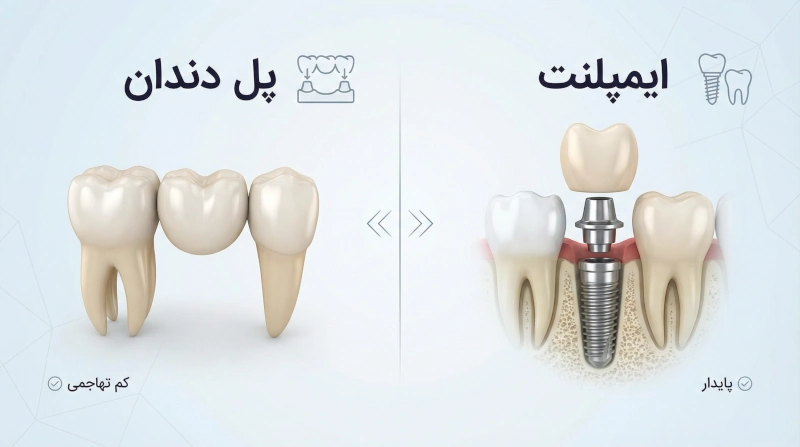

When a tooth is lost, the first question that concerns the mind of many people is what is the best replacement method? Bridge or implant? Is dental bridge or implant better? The answer to this question is not the same for everyone; Because every patient has different bone conditions, oral health and expectations.
Due to its high similarity to the natural root and the ability to last longer, dental implants are usually the best option for people who have good jawbones, are looking for a stable result, and want a replacement tooth without relying on adjacent teeth. On the other hand, a dental bridge or bridge can be a good choice for those who do not want to do surgery, need a faster result, or their side teeth also need restoration, and those teeth can be used as a base.
In this article, we discussed the difference between bridge and implant and by carefully examining the differences, advantages and limitations of both methods, as well as analyzing their cost and impact on oral health, we will help you make a more informed decision about which option is more suitable for your situation.
If you are a resident of Karaj, call 09129559071 or fill out the following form for consultation with implant specialist in Karaj
dental implant; A modern and lasting replacement
Dental implant is one of the most advanced and successful methods of replacing lost teeth; A method that, due to its titanium structure, creates a function very similar to the natural root of the tooth. When the implant base is placed in the jawbone, it gradually bonds with the bone and creates a strong support for the final veneer. This feature has made the implant one of the most permanent choices in dental treatments.
Since jaw conditions, oral health and patient expectations are different, there are different types of dental implants. Normal implant is the most common type, which is performed according to global standards and in most cases has a completely stable and predictable result.
For patients who are looking for more speed in the treatment process, immediate implant is a suitable option; Because in some situations, it is possible to place a temporary cover on the same day of surgery. Along with these two, digital implant is considered a new generation of dental implants which, by using 3D imaging and software programming, brings the accuracy of implantation to a much higher level.
The presence of this wide range of methods has made the dental implant compatible with all kinds of needs and conditions of patients. Whether the patient's goal is to restore the beauty of the smile or to improve the chewing function, the implant is considered a permanent and reliable choice due to its high strength, natural appearance and remarkable lifespan.
Dental implant steps and recovery period
The dental implant process is usually done in several steps and its purpose is to create a strong and lasting foundation for the final cover. The first stage begins with specialized examination and imaging; At this stage, the condition of the jaw bone, gum health and the general condition of the mouth are checked to determine whether the patient is a suitable candidate for an implant or not. If needed, treatments such as scaling or bone grafting are also performed before surgery.
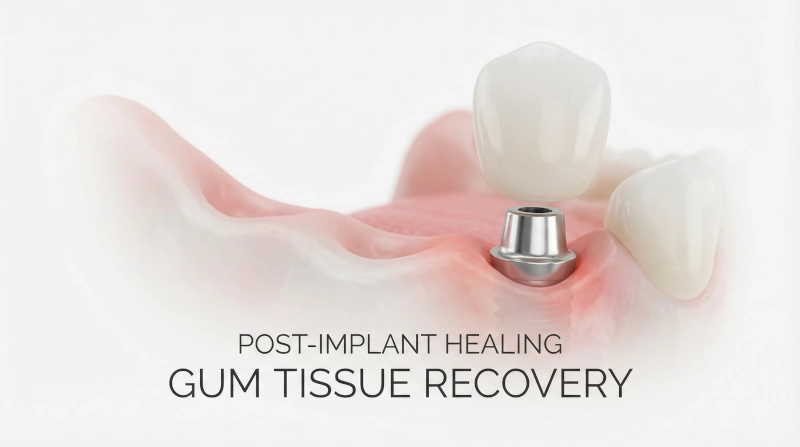
After preliminary examinations and preparation of the patient, the main step is placing the fixture (implant base) in the jaw bone. This surgery is usually performed under anesthesia and the patient does not feel pain during the procedure. After the placement of the base, the gum is closed at the surgical site to start the process of bone grafting and implant. This period, which is called implant welding, usually takes a few weeks to a few months and plays a very important role in the final success of the treatment.
After that, an intermediate piece between the base and the tooth, called an abutment, is installed, and in the last step, the final tooth cover is placed on it to complete the function and appearance of the tooth.
Dental implant recovery period is relatively tolerable compared to many surgical procedures. Most patients feel some swelling or tenderness during the first day or two, which resolves. Observing oral hygiene, avoiding eating hard foods and taking prescribed medications will help the healing process go faster and without problems.
After a few days, the patient can usually resume his daily activities, and after the implant is completely fixed, the smile and the normal function of the teeth will return completely.
We suggest you also read the article Dental Implant Stages.
dental bridge; A traditional but still practical method
Dental Bridge (Dental Bridge), which is called a dental bridge, is one of the old and proven methods for replacing lost teeth. The choice of the title "Paul" is quite descriptive; Because this structure works exactly like a real bridge and covers the gap created in the edentulous area by relying on the adjacent teeth.
In this method, one or more veneers are designed integrally and are connected to the teeth on both sides of the edentulous area. This connection makes the function of chewing and the beauty of the smile return to a large extent, without the need to place a base in the bone like an implant. The elimination of surgery and the shorter duration of treatment are among the reasons that still make the bridge a practical option in many treatments.
Although the bridge is not as modern as the implant in terms of technology, it can provide acceptable and efficient results in situations where the side teeth need to be repaired or the patient does not have the necessary conditions for implant placement. Good durability and the ability to restore the relative function of the tooth has kept this method among the common dental options.Steps of dental bridge and recovery time after that
The process of preparing and installing a dental bridge is usually done in a few sessions without the need for surgery. In the first stage, the teeth on both sides of the edentulous area are prepared to play the role of supporting bases of the bridge. This process involves controlled grinding of the surface of the teeth to provide enough space for the placement of protective veneers. Next, accurate molding is done in the desired area so that the laboratory can design a bridge that fits the shape of the mouth, the height of the bite and the color of the teeth.
After the bridge is made, it is tested on the base teeth in the next meeting and fixed with special materials after ensuring a perfect fit. This integrated structure restores the dental connection, the partial return of chewing function and improves the appearance of the smile.
The recovery period after bridge installation is usually short. Most patients feel a little sensitivity to pressure or temperature changes during the first day or two, which is normal and gradually decreases. It may take a few days to a week to get used to the new structure. Observing oral hygiene, avoiding chewing very hard materials and visiting the dentist regularly will increase the lifespan of the bridge and prevent damage to the primary teeth.
Is dental bridge or implant better in terms of durability, oral health and the effect on adjacent teeth?
Implant usually has a significant advantage over a bridge. The titanium base of the implant, after being grafted with the bone, functions like a natural root, and if oral hygiene is followed, it can remain unchanged for years.
Although a dental bridge can function properly for years, its life depends on the health of the underlying teeth, and if these teeth are damaged, they need to be replaced or reconstructed.
Dental bridges usually need to be replaced every 10 to 15 years, while implants can last up to 25 years or even longer if properly cared for.
https://anveli.dental/dental-bridge-vs-implant/#:~:text=Bridges%20typically%20need%20replacement%20every,teeth%20rather%20than%20just%20one.
The effect of these two methods on oral and dental health is also different. The implant only fills the empty space of the missing tooth and is not dependent on other teeth; Therefore, it preserves the natural structure of the mouth and prevents further erosion of the jaw bone. On the other hand, the bridge requires the grinding of adjacent healthy teeth for installation, and this issue may endanger the health of these healthy teeth in the long run. In addition, plaque accumulation is more likely under the bridges and requires more careful care.
As we said, in terms of the effect on the adjacent teeth, the implant is an independent treatment and does not impose any additional burden on the side teeth; Rather, by imitating the natural root, it maintains the natural stability of the dental arch. But the bridge transfers the weight and pressure caused by chewing to the base teeth and over time can reduce their strength or cause sensitivity and decay, especially if oral hygiene is not fully observed.
To sum up, although both methods can be an effective replacement for missing teeth, the difference in durability, maintaining oral health and minimizing damage to adjacent teeth has made implants a more stable and conservative choice in many cases.
Is dental bridge or implant better? Advantages and disadvantages of each method
| Comparison subject | Dental implant | Dental bridge (bridge tooth) | |
| Treatment definition | Complete root and crown replacement with a titanium base that is placed in the jawbone. | Space filling Toothlessness with a single coating relying on the side teeth. | |
| The most important advantages | • High durability and function similar to natural teeth • Prevention of jaw bone loss • Complete preservation of adjacent teeth • Long-term beauty and stability | • Faster treatment • No need for surgery • Lower initial cost • Suitable if adjacent teeth need to be repaired • Higher cost | • Grinding of healthy side teeth • Possibility of decay or weakness of primary teeth • Failure to prevent bone loss • Shorter duration than implants |
| Effect on adjacent teeth | Completely independent from other teeth; It does not put any pressure on the side teeth. | It depends on the side teeth and creates pressure and grinding on them. | |
| Durability and longevity | very high; It can last for decades if properly cared for. | Medium; It usually needs to be replaced or repaired after a few years. | |
| The degree of invasiveness | Surgery is necessary, but it is done with anesthesia. | No surgery and with minimal Invasion. | |
| Maintaining jawbone health | Preventing bone resorption due to the same function as a natural root. | It has no role in preventing bone resorption. | |
| Suitable for whom? | Patients who are looking for a permanent and natural solution and have suitable jawbone conditions. | Patients who do not want to do surgery or whose primary teeth need veneers have. | |
| Approximate cost | Higher due to the use of advanced materials and technologies. | Lower and more economical in short term. |
Dental bridge cost compared to implant
The cost difference between dental bridge and implant is more related to the nature and complexity of each method. Dental implants are usually more expensive because they include the use of a titanium base, an intermediate piece (abutment), a final coating, and in some cases detailed imaging and specialized planning. In addition, if the patient needs additional treatments such as bone grafting, the overall cost will increase.
On the other hand, dental bridge as a non-surgical treatment is usually performed with a lower initial cost. Its cost mainly depends on the number of bridge units, the materials used and the condition of the base teeth. But it should be noted that despite the lower cost at the beginning, the shorter life of the bridge and the possibility of damage to the base teeth may require alternative treatments or more restorations in the long term.
In general, the implant has a higher therapeutic value in terms of durability and functional stability, while the bridge can be a more economical and faster option for patients who are looking for a less invasive and more cost-effective solution. The final decision, depending on the conditions of the jaw, oral health and the patient's expectations, should be determined by the expert's opinion.
last word; Is a bridge better or an implant?
In this article, we thoroughly investigated whether a dental bridge or an implant is better, in general, a dental implant is suitable for patients who are looking for high durability and maintaining the health of adjacent teeth, and a dental bridge is a good choice for people who do not want to do surgery or need faster treatment. Both methods, depending on the condition of the jaw and the patient's expectation, can provide a favorable result.
In the center of gum and implant surgery of Dr. Fermer and Dr. Shanei, both procedures are performed with high precision, standard equipment and by experienced specialists. If you want to know which option is more suitable for you, book an appointment for a specialist consultation now; Your smile starts with a right decision.
Phone: 02634001968
Address: Karaj, Beheshti St., between Shahada Square and Taleghani Crossroads, 7th Floor, Unit 23, Qaem Doctors Tower



No comment has been registered yet, you are the first to post a comment.
Submit a comment