trigger points

Trigger points
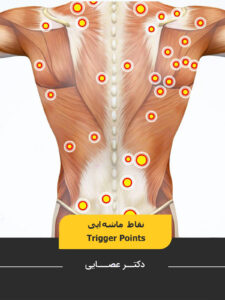
Trigger points are commonly defined as hyperexcitable points in skeletal muscle. These points, also known as muscle knots, are like tight knots in skeletal muscles that feel tender, twitch, or jump when touched or pressed. Postural muscles are most affected by trigger points. These tender points may actively develop in the injured muscle or trigger other tender points elsewhere in the body. Trigger points can usually occur in two forms, active and latent. Active trigger points are those that immediately cause intense discomfort and can be recognized as soon as they form. While hidden trigger points do not show themselves at first and get worse with age and other factors. Stay with us until the end of the article to learn more about the treatment of trigger points and its symptoms.
Symptoms of trigger points
Pain is the most obvious symptom of a trigger point. This means that trigger points usually send their pain in another direction. Generally, a trigger point is like a hard "lump," knot, or band in a muscle. Here, we list the most important signs and symptoms of trigger points:
- Hardness and hardness
- Muscle weakness
- local sweating
- eye tears
- High secretion of saliva
- Poor balance
- dizziness
- Moor Mor Mor
- Running nose
- Headache
- muscle cramps
In some cases, trigger points can also appear as tension headaches, tinnitus, temporomandibular joint pain, reduced range of motion in the legs, and back pain.
Causative factors
Trigger points are often caused by muscle injuries, strains and trauma. In addition, structural imbalance, improper body mechanics, improper nutrition, and stress are also major aggravating factors. When muscle fibers, fascia, ligaments, or tendons become weak, stretched, or inflamed for any of the reasons listed above, tiny tears develop in the associated soft tissue. When this tissue begins to heal, it contracts, twists, and knots. These tangled fibers further restrict the fresh blood needed by the muscle cells. The muscle fiber is also often shortened to protect it from further damage. This in turn can lead to loss of joint range of motion. In most cases, such injuries and processes eventually lead to the creation of trigger points in these muscles and related structures.
Recognition of trigger points
Trigger points do not show up in medical lab tests or imaging. However, they are easily diagnosed by examining the muscle for the following:
- Tight muscle bands
- Tender mass that refers to pain on pressure
- (sometimes) when the trigger point is pressed, the muscle contracts ("jump sign")
Treatment methods of trigger points
There are a series of treatment methods to treat trigger points.
The most common method adopted for this purpose is massage therapy. In this method, static compression is applied intermittently to the affected area and it is relieved in the form of pumping in order to eliminate toxins and calm the nerves.
In addition, a diet rich in antioxidants is also recommended as part of a treatment plan to relieve pain caused by trigger points.
Other treatment options available for this purpose include mechanical vibration, pulsed ultrasound, electrical stimulation, ischemic compression, dry needling, and traction techniques. Finally, trigger point injections are often used for immediate pain relief, especially when most other methods have failed to produce the desired result.
Find the best trigger point treatment
Many clinical trials have been conducted for trigger point therapy. We have summarized the results of these cases below. However:
Because researchers usually only measure symptoms rather than eliminate trigger points, tests are of limited use. That's why we need to see what trigger points are and how they are created and what treatments will help you to improve trigger points.
As we have seen, trigger points are a combination of muscle spasm, stiffness, reduced blood flow, and waste accumulation, all of which reinforce each other and form a positive feedback loop. The goal of trigger point treatments is to reduce or stop that cycle. This can be done in any part of the loop. That's why we have different trigger point treatments. In general, it can be said that trigger points are rooted and stubborn.
All scientific information and clinical experience tell us that trigger points develop slowly over time and become very ingrained. Therefore, any therapeutic application can only slightly reduce the ring. If the treatment is repeated continuously, the ring will continue to decrease, but of course if the treatment is stopped after the end of the damage to the trigger points, they will gradually develop again and worsen again.
waist and neck 1654 played 49مقالات دیگر از Dr. Seyed Hossein Isa

SEO site management services
Search engine optimization (SEO) services help you to rank your website higher in the search results of Google and other search engines.

Implementation of branding and digital advertising
Digital branding means creating a strong and distinctive brand in the digital space for a company or a specific product. This process involves using digital methods and strategies to build and strengthen the brand.

Website design for companies and businesses
Website design for companies and businesses can help you have a stronger online presence and attract more customers. Contact us for more information.
